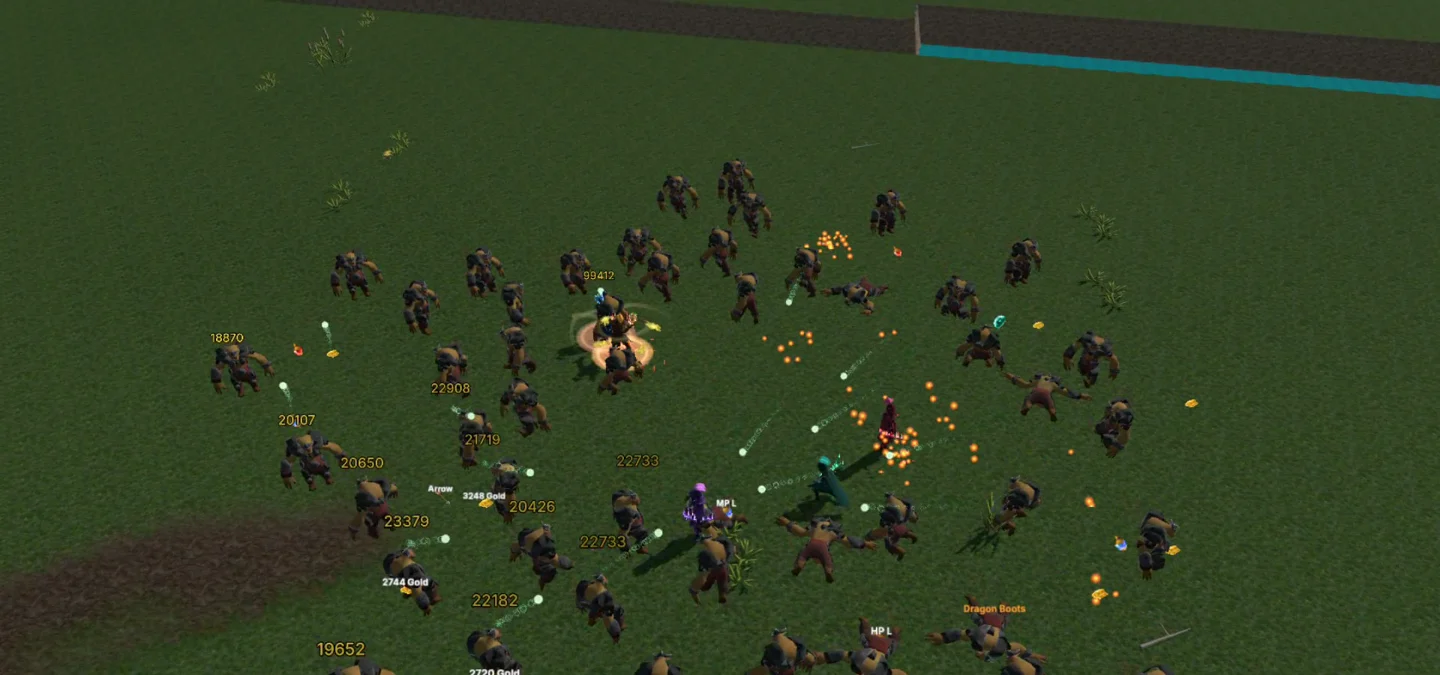
How Genesis actually works — classes, growth, gear, PvP and the world. Every number here is the one the server uses.
Genesis is built to the 2003 rules, but it is not bound by the 2003 conveniences. These are the parts the original never had.
Not just the buttons. Every monster name, every item, every quest and every system message is written in Arabic, right to left, and a test refuses to build the game if a monster or item is missing its Arabic name. This site is bilingual for the same reason.
Your camera, your action bar, your key bindings, your window positions and your language belong to your account, not to the computer. Share a machine with someone and you each keep your own; sit at a new one and the first login brings your setup with it.
Classic for the original fixed angle, Modern for free orbit, Follow for a view that swings back behind you as you walk.
When the server refuses something, it says what stopped it, on screen, in your language. No click that quietly does nothing and leaves you wondering whether it was sent.
A name is one alphabet — Latin or Arabic, never mixed — so no one can register a lookalike of yours out of characters that merely draw the same. Names are refused outright rather than silently rewritten into something you did not choose.
One game, three platforms, from the same build. The original was Windows and nothing else.
What a monster drops is yours alone for the first ten seconds, so the player who did the work gets first reach. On a team you can choose to share money and items instead.
Packing up a stall, dropping an item, leaving the world — anything you cannot undo asks first, and cancelling leaves everything exactly as it was.
Under all of it the server is the authority on everything that matters: your client draws what the server says and never decides an outcome for itself. That is what a load test of two thousand players on a single map is for, and the realm holds its tick rate through it.
Four classes. You pick one when you create your hero, and it decides what you can hold and what you can learn.
Two one-handed weapons at once, no shield. The fastest melee opener: Fast Blade down a line, Cyclone for a burst of speed, Hercules to break the ground around you. Blade and club passives fire on ordinary swings.
Weapon and shield, or a spear. The one that stands still and survives: Guard halves incoming damage, Shield triples defence for a window, Superman turns a fight around. Dash drives down a lane with a spear.
Bow, and arrows are real items you carry and spend. Scatter fans a volley, Rapid Fire pours arrows down a lane, Intensify is one heavy shot. Fly and Elementary Fly lift you out of melee reach.
Wand, magic, and the only class that heals. Thunder and Toxic to start; then a path. Water heals and raises the fallen, Fire burns groups down.
A Taoist follows one of two paths. Water is the support half: Cure, Advanced Cure, Healing Rain, Nectar, and the two resurrections, Revive and Pray, which put a fallen hero back on their feet where they lie. Fire is the damage half: Tornado, Fire Circle, Fire of Hell and Fire Meteor. Meditation belongs to neither and restores mana for stamina.
Weapons are Fist, Blade, Sword, Club, Spear, Bow, Wand and Backsword. What you can equip is gated by your class and level, not by preference, and some skills demand a specific weapon in hand — Dash needs a spear, Hercules needs two one-handed weapons, Weapon Mastery needs a club.
Levels, skills and weapon proficiency all rise separately, and every one of them rises by doing rather than by spending.
Levels run from 1 to 130. Each level up adds 10 to your maximum health and refills both pools on the spot.
Your four attributes come from the class you picked and stay where that class put them — there is no point-spending screen, and no build to get wrong at level 8. What the four do still matters, because your gear and your skills are read against them.
| Attribute | What it does |
|---|---|
| Strength | Physical attack |
| Agility | Accuracy and dodge |
| Vitality | Maximum health |
| Spirit | Maximum mana and magic power |
You carry three pools. Health and mana are the familiar two. Stamina is the third, and it is what martial skills cost — Taoist magic spends mana instead, and bow skills spend arrows on top. Stamina refills at full rate while you stand still and at half rate while you move, so standing between fights is how you get it back.
Skills level by use. Casting a skill earns it experience, and each skill has its own cap; a skill at its cap hits harder and reaches further than the same skill freshly learned. You learn skills from books, which drop and are sold.
Weapon proficiency is separate again, and it also levels by use — every landed swing trains the proficiency for the weapon type in your hand. It runs 1 to 20, worth 1.5% per level, so a capped proficiency is a 28.5% bonus with that weapon type. Switching weapon type means starting that type from where you left it.
Some skills are ultimates and are not paid for with a pool at all. They fill a charge meter that rises on its own over about four minutes and faster as you kill, and once full you have a short window to spend it.
Three camera modes. The original had one, and you were never asked which you preferred.
The fixed isometric angle, exactly as the original framed it. You can zoom, and nothing else moves. If you came here for the 2003 silhouette, this is it.
Free orbit. Drag to swing the camera anywhere around your hero and scroll to zoom. The angle you leave it at is the angle it keeps.
The same free orbit, but walking eases the view back around behind you. Your chosen height and distance are left alone — only the direction follows.
Middle-drag orbits out of the box, and right-drag is there if you prefer it. That is a setting for a real reason: right-click is how you attack, so on the wrong binding every swing that nudged the mouse also swung the camera. A click too short to count as a drag stays a click, so grabbing the view never costs you the skill you meant to throw.
The camera stays exactly where you put it. No mode moves your zoom or your height on its own, and walls between you and your hero are drawn through rather than dodged — the view never lurches in and out by itself because a roof crossed the sightline.
Everything worn has a quality, a plus level, and up to two sockets. All three stack, and all three survive an upgrade.
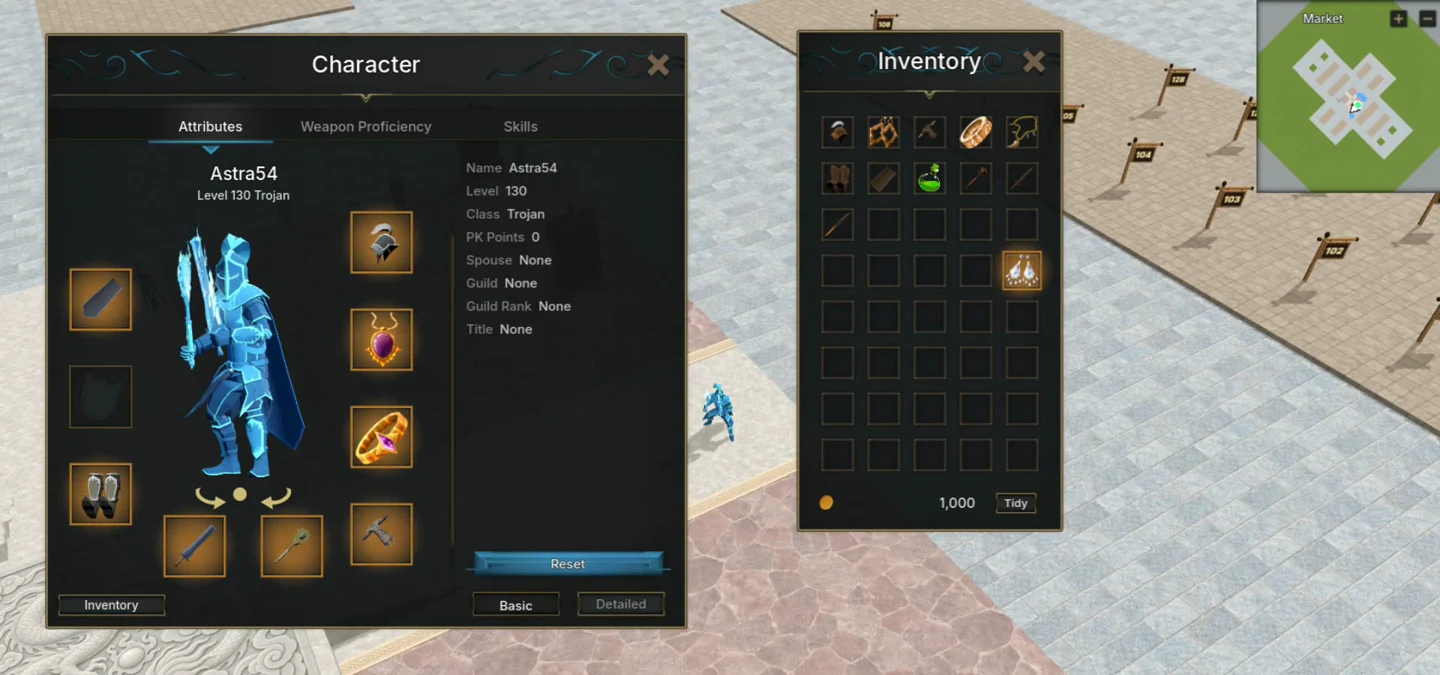
You wear seven pieces: helmet, necklace, armour, right weapon, left weapon, ring and boots. The left hand holds a shield, a Trojan second weapon, or an Archer quiver.
Every piece rolls a quality when it drops. Quality multiplies the whole piece, so the same item at Super is worth 45% more than at Normal.
| Quality | Multiplier |
|---|---|
| Normal | × 1.00 |
| Refined | × 1.10 |
| Unique | × 1.20 |
| Elite | × 1.30 |
| Super | × 1.45 |
On top of quality sits a plus level, +1 to +9, bought with plus stones at the artisan. The steps get expensive fast — 1, 1, 2, 3, 5, 8, 13, 21 and 34 stones — and the payoff climbs just as steeply.
| Plus | Bonus |
|---|---|
| +1 | 1 |
| +2 | 2 |
| +3 | 5 |
| +4 | 10 |
| +5 | 20 |
| +6 | 35 |
| +7 | 60 |
| +8 | 90 |
| +9 | 130 |
A piece holds up to two sockets. The artisan opens them, and opening is not guaranteed — the first socket fails one time in five, the second one time in two. A gem goes in each socket, and gems come in three grades worth ×1, ×1.5 and ×2.
| Gem | Effect |
|---|---|
| Dragon | Physical attack |
| Phoenix | Magic attack |
| Fury | Hit accuracy |
| Rainbow | Experience gained |
Upgrading a piece to the next tier carries its plus, quality, sockets and gems across, which is why working one item is cheaper than grinding a fresh drop up from nothing. Upgrades cost Meteors, and the final step costs a DragonBall — one DragonBall is 100 Meteors.
Worn gear loses durability and stops helping when it runs out. Any repair NPC mends it for a quarter of the item price. The dyer recolours a worn piece for 50 Meteors, and the glow — the rim shine and the +5 ember aura — costs one DragonBall.
Potions come in three tiers gated at levels 1, 40 and 90, restoring 150, 500 and 1500 health, or 80, 300 and 900 mana. Arrows are ordinary stackable items: an empty quiver refuses the shot.
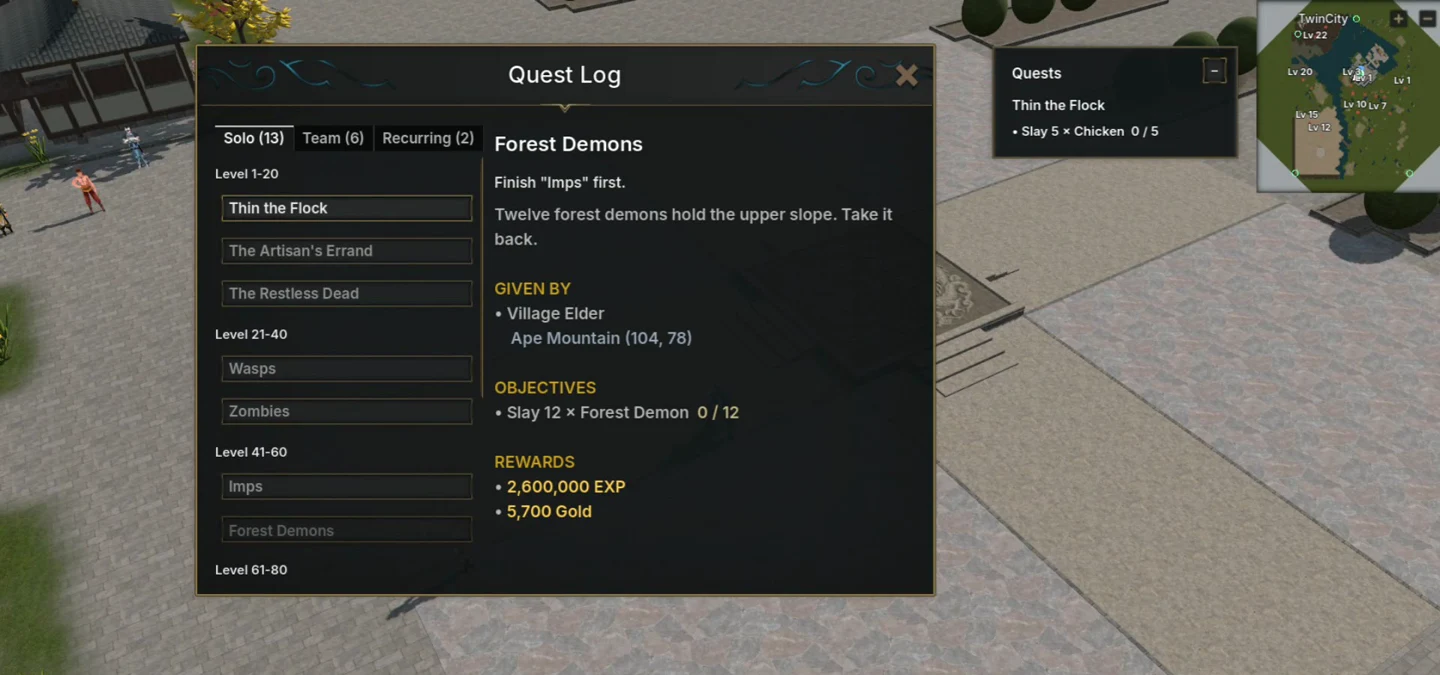
Sixteen quests, one chain of elders, one per region.
Each of the five regions has an elder who hands out that region's quests, and the chain runs in the order you meet the regions: Twin City, then Phoenix Castle, Ape Mountain, Desert City and Bird Island.
Eleven are solo hunts — thin out a mob type and come back. Five are boss quests and demand a full team of four: the Ghost King, the Bandit King, the Snakeman King, the Blade Ghost King and the Robber King, one at the end of each region's chain.
Objectives come in four shapes: thin out a kind of monster, bring back a number of an item, speak to someone, or reach a place. A quest can ask for several at once, and all of them have to be satisfied before it will take a turn-in.
When an item is what a quest wants, the monsters you kill roll for that item on top of whatever they were already going to drop, and only while a quest of yours is still asking for it. So a collect objective is not a wait for the ordinary loot table to cooperate, and the fifth cap never lands after you needed four.
Kills count for everyone on the team who was near enough, so a party clearing a quest clears it together rather than taking turns for the credit.
The log carries every quest you can see, grouped by whether it is solo or team work, and a quest you cannot start yet says which requirement is stopping you — your level, the size of your team, or a quest further back in the chain. You never have to guess why an elder will not talk to you.
Quests pay experience and gold, and the team bosses pay a cape.
You choose who you can hit. Killing the innocent stains your name, and a black name goes to jail.
Your attack mode decides who your swings can land on, and you set it yourself.
| Mode | Who you can hit |
|---|---|
| Peace | Monsters only |
| PK | Anyone |
| Team | Anyone outside your team |
| Guild | Anyone outside your guild |
| Capture | Only red and black names |
Killing a player who was not flagged adds 20 PK points. Points fall away on their own, one per minute, so a single killing fades in twenty minutes and a spree does not.
| PK points | Name | What it means |
|---|---|---|
| Under 30 | White | Ordinary. Capture mode cannot touch you. |
| 30 to 99 | Red | Fair game for anyone in capture mode. |
| 100 and over | Black | Hunted by guards, and jailed on death. |
A black name who dies is sent to jail for two minutes and released to Twin City. The Warden will let you out early only once your PK has fallen back under 100. Jail is a safe zone: nothing can be fought inside it.
Guild War is the exception to all of it — inside the war window the map is a free-for-all between guilds, and dying there costs a thirty-minute jail sentence instead.
Five regions, plus the places built for one purpose.
| Map | What it is |
|---|---|
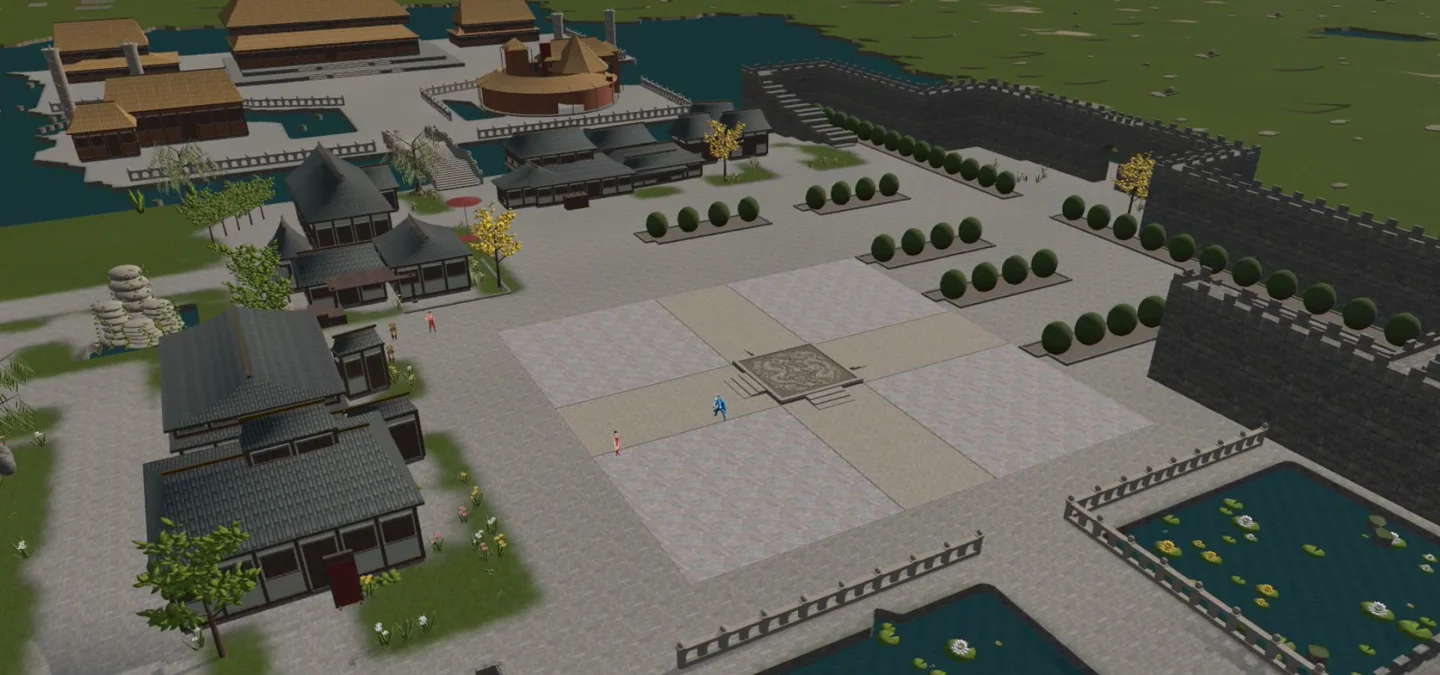
| Twin City | The hub. Everyone starts here, and every release from jail lands here. |
| Phoenix Castle | The second region, in maple forest. |
| Ape Mountain | Canyon country, and the apes it is named for. |
| Desert City | Open desert. |
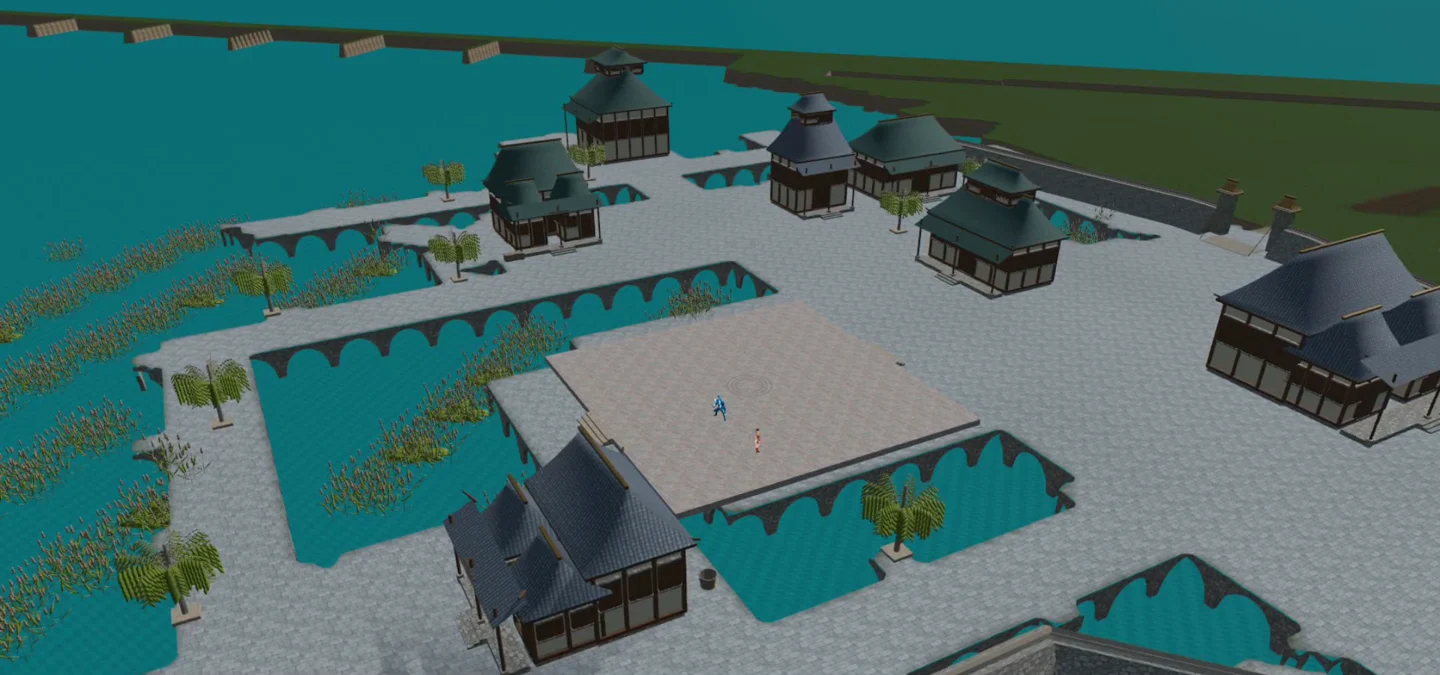
| Bird Island | Reed island, and the largest map in the game. |
| The Market | The player bazaar. 144 stall pitches and no monsters. |
| Guild Area | The guild-war ground, where the pole and the gates stand. |
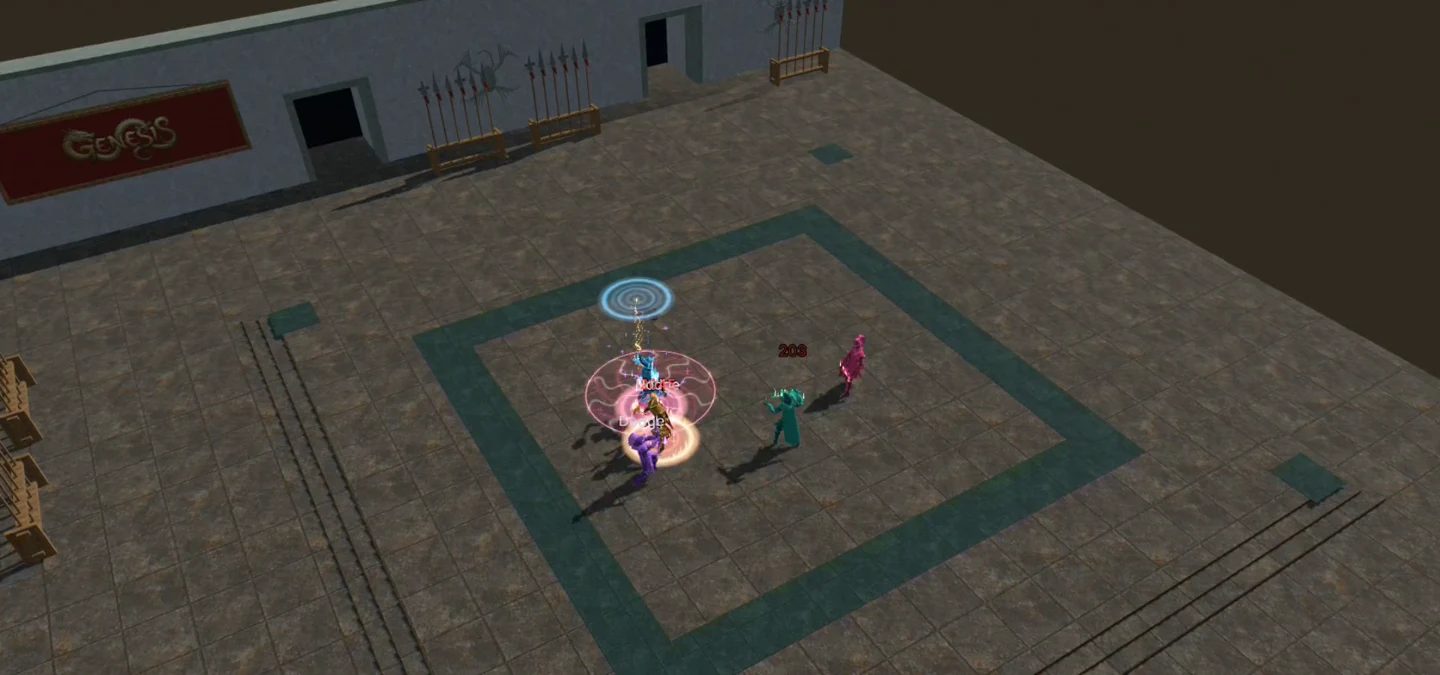
| Arena | The original combat arena. |
| Jail | Where black names go. A safe zone. |
You travel by portal, by the conductress in each city, or with a gate item that takes you straight to a city you have unlocked.
What you hunt, and what it leaves behind.
Monsters are spawned into regions in bands matched to level, so a region has ground worth hunting whatever level you arrive at. They chase, they leash back when you outrun them, and they respawn on a timer.
A kill can drop gear, and gear rolls its own quality and sockets as it falls — most drops are Normal with no socket, and a Super drop with two sockets is rare enough to be worth the walk back. Kills also drop potions and arrows, and much more rarely the upgrade materials: plus stones, quality stones, Meteors and DragonBalls.
Loot belongs to whoever earned it for a short while before anyone may take it, and it disappears if nobody does.
Playing together
Teams, friends, guilds, trade and stalls.
A team is up to four heroes. Experience is shared with team-mates who are near enough to see the kill, so a team that scatters across the map stops sharing.
You keep a friends list and an enemies list, and you can inspect any hero to see what they are wearing.
Founding a guild takes level 15 and 1,000,000 gold. A guild holds up to 50 members across three ranks — leader, deputy and member — with a shared fund and a bulletin the leader writes. Guilds can ally with and declare on one another.
Guild War runs every Saturday from 20:00 to 23:00 server time, announced half an hour ahead. Guilds fight over the pole in the Guild Area: take it, hold it, and defend the gates. The guild holding the pole when the window closes takes 30,000,000 gold, and 10% of the losing fund goes with it. The leader can heal the pole during the war for gold.
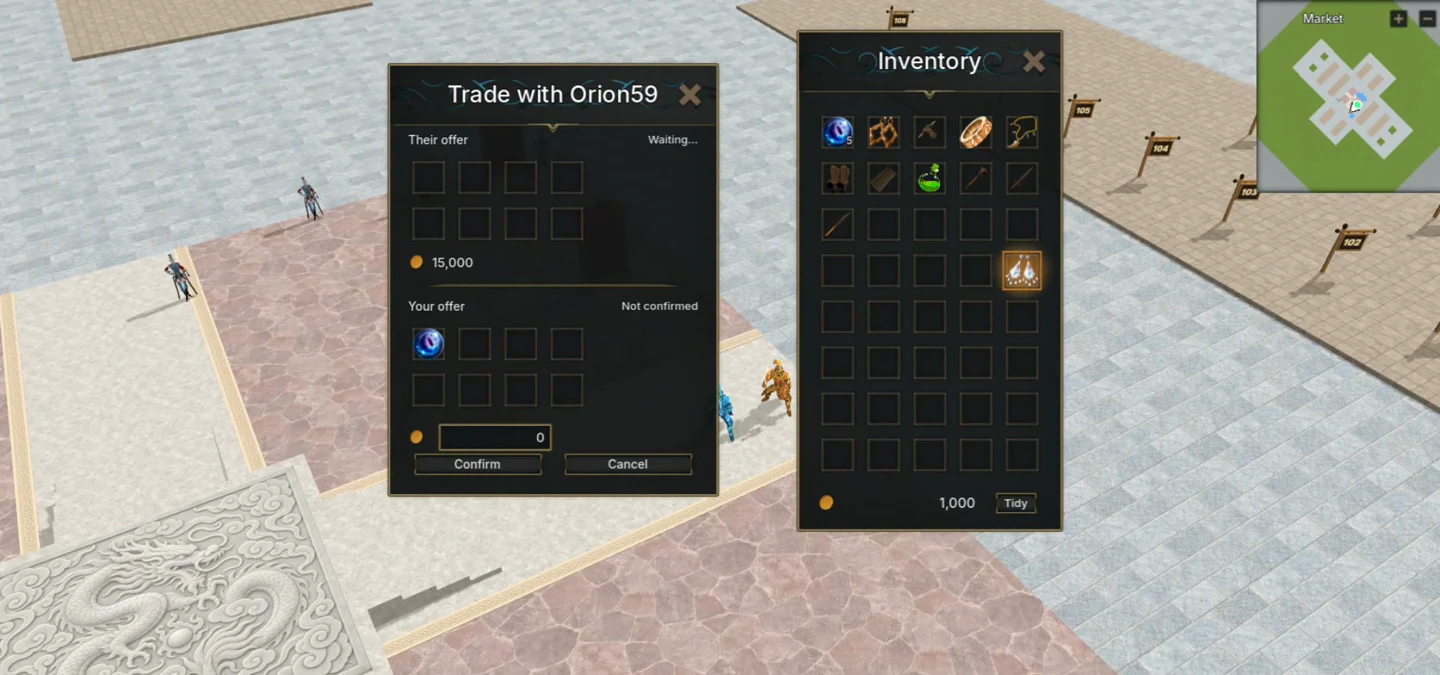
Two players can trade face to face, gold and items both. For selling without a buyer present there is the Market, which carries 144 numbered stall pitches — claim an empty one, stock it, set your prices, and it sells while you stand there. Packing up asks you to confirm first.
The warehouse keeps items and gold you do not want to carry, and what is banked is safe.